

A first mild reaction is not a guarantee of what comes next, but allergies often build over time. With repeated exposure, the immune system tends to become more sensitized, so signs that were mild this season can appear sooner or hit harder the next. Atopic and seasonal allergies in particular tend to intensify year over year rather than quietly fade on their own. That is why an early exam and a written plan matter: recognizing the pattern now gives your pet the best odds of staying comfortable as the years go on.
At Cane Bay Veterinary Clinic, we see pets with allergies nearly every day in Summerville, and we get to know your pet and watch how their allergies behave from one season to the next. During an exam we look at the whole picture and help you build a preventive care plan you can adjust as your pet grows, and because every member of our team is Fear Free Certified, that visit stays calm instead of stressful. We offer a free first exam for all new clients so you can experience the Cane Bay difference. If a reaction ever escalates, call us right away. Request an appointment and we will start mapping out your pet’s plan together.
Hives, Anaphylaxis, and Everything in Between
- Allergic reactions in dogs and cats fall on a spectrum, from chronic itchy skin that needs steady management to anaphylaxis, a sudden whole-body emergency that unfolds in minutes.
- Hives, facial swelling, and welts usually call for same-day attention, while collapse, pale or blue gums, repeated vomiting, or open-mouth breathing in a cat mean you head to the nearest open hospital right now.
- Most chronic allergies trace back to environmental triggers, food proteins, or fleas, and finding the trigger matters more than treating each flare as it comes.
- Real long-term relief usually combines the right medication, year-round parasite prevention, and sometimes immunotherapy, and most well-managed pets stay comfortable season after season.
What Sets Off an Allergic Reaction in the First Place?
Most allergic reactions trace back to one of three sources: what your pet breathes in or brushes against, what’s in their food, or run-ins with insects and parasites. Many pets are allergic to more than one trigger, and finding the true cause of your pet’s symptoms comes down to their history and diagnostic testing.
- Environmental allergens: Pollen, grass, mold, and dust mites are the usual drivers behind atopic dermatitis, the itchy, inflamed skin disease that tends to flare seasonally as those allergens rise and fall through the year.
- Food proteins: Beef, chicken, dairy, and other everyday proteins can provoke a food allergy, and because your pet eats them all year, the itching and tummy upset usually run steadily instead of in seasonal waves.
- Insects and parasites: Flea bites causing flea allergy dermatitis are the classic offender, but bee and wasp stings can set off anything from a puffy local bump to a whole-body reaction.
Summerville pets have it harder than most when environmental allergies are in play. Our Lowcountry spring starts early with pine pollen dusting every car hood yellow by March, live oaks following close behind, and Bermuda grass carrying the itch through summer until ragweed takes the handoff in fall. Add the humidity that keeps mold and dust mites thriving indoors all year, and an atopic pet here rarely gets a true off-season.
Can My Pet Be Allergic to Vaccines and Medications?
Vaccines and new medications sit in their own small category. Most pets shrug off their shots with nothing more than a day of mild soreness or tiredness, but the vaccination reactions that warrant a call, like facial swelling, welts, repeated vomiting, or any trouble breathing, tend to show up within minutes to a few hours. A brand-new prescription carries that same low risk, which is why any past reaction belongs in your pet’s chart before the next dose. We review that history as part of routine wellness care, so patterns get flagged early rather than rediscovered the hard way.
Will My Pet Grow Out of Their Allergies?
Unfortunately, no. Unlike children who sometimes outgrow a food allergy, dogs and cats almost never leave their allergies behind, because the tendency is written into their genetics and the immune system’s memory of a trigger doesn’t fade with age. Most pets are diagnosed between one and three years old, and the condition then stays for life.
The reason comes down to how allergies work. Each exposure teaches the immune system to recognize the trigger faster and respond harder, a process called sensitization, so the reaction tends to start earlier in the season and climb higher year over year. Many pets also add new triggers to the list as time passes: the dog who began with a mild spring grass allergy may react to ragweed, dust mites, and fleas a few years later, stretching a six-week itchy season into most of the year.
How Do I Know If My Pet’s Allergic Reaction Is an Emergency?
Two things tell you how urgent a reaction is: how fast it came on, and how far beyond the skin it’s spread. Signs that build slowly over weeks rarely count as emergencies, while anything that erupts within minutes to hours and starts touching breathing, gum color, or alertness needs care right now.
| Urgency tier | What it can look like | What to do |
| Watch and schedule | Ongoing itching, licking or chewing, recurring ear infections, patchy hair loss | Book an exam so we can find and treat the underlying allergy |
| Same-day care | Hives or welts, a swollen muzzle or face, one bout of vomiting, a single sting with local swelling | Call us and come in the same day |
| Emergency now | Collapse, weakness, pale or blue gums, repeated vomiting and diarrhea, open-mouth breathing in a cat, swelling near the throat | Get to the nearest open veterinary hospital immediately |
On the way in, a few small moves matter. Note when the signs started and anything new your pet ate, touched, or got stung by, and bring the suspected trigger along if you can grab it safely. Resist the urge to induce vomiting or give a human antihistamine without our okay, because the wrong choice or dose can do real harm. Watch your pet’s breathing, and check the gums: healthy pink means good circulation, while gums that turn pale, white, or bluish signal that not enough oxygen is reaching the tissues and your pet needs to be seen immediately. For hives, a swollen face, or a reaction that’s clearly building, call us as you head over so we can be ready for your pet.
Why Does My Pet Keep Getting Itchy Skin and Ear Infections?
Chronic allergic skin disease is the most common face of pet allergies, and it rarely clears up on its own. The allergy inflames the skin and ears, the scratching opens the door to secondary infections, and the whole loop repeats each season until the underlying allergy gets diagnosed and managed. These reactions fall into the “watch and schedule” category; usually not an emergency, but certainly worth a visit to help control the itch and skin infections that come with it.
Chronic Skin Reactions in Dogs
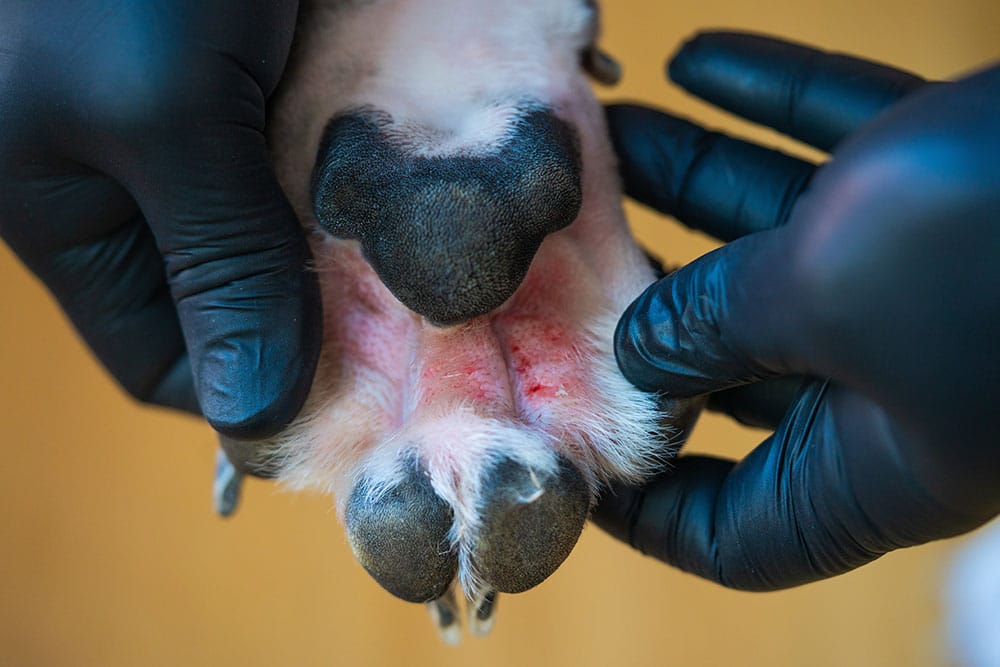
In dogs, the tell is often the sound before the sight: that rhythmic lick-lick-lick of a paw at 2 a.m. Constant licking and chewing leave red, irritated patches, thinning fur, and skin infections that flare and fade. The most common problem spots we see:
- Between the toes, inflammation shows up as pododermatitis, and when it burrows deeper it becomes interdigital furunculosis, tender nodules that make every step hurt.
- A spot licked raw can erupt into a hot spot almost overnight.
- Those recurring ear infections are rarely random: in an allergic dog, chronic otitis externa is usually the same allergy flaring in the ear.
Chronic Skin Reactions in Cats
Cats are quieter about all of this. Many groom in private, so the first clue isn’t the obvious licking but the result:
- Overgrooming causes a strip of missing fur down the belly or inner legs, neat and symmetrical, from working over a spot that itches.
- Miliary dermatitis, a scatter of tiny crusty bumps, feels like grit through the coat before you ever spot them.
- Raised, firm sores on the lips, belly, or backs of the thighs known as the eosinophilic granuloma complex is often seen with flea-allergic cats.
Are Hives and Swelling Something to Worry About?
Hives, respiratory changes, and swelling sit in the middle tier of allergic reactions: not necessarily an emergency right now, but deserving of prompt care because they can escalate to an emergency quickly.
- Hives surface as raised welts within minutes to hours of a trigger, and while they often settle on their own, they can just as easily be the opening act of something far more serious.
- Breathing is the other thing to watch. Airway conditions like feline asthma and allergic bronchitis can flare fast when a trigger hits, turning a little coughing or wheezing into real distress within a short window.
- While most insect stings amount to a yelp and a bit of swelling, a sting crosses into urgent territory when it lands on the face, mouth, or throat, when several land at once, or when whole-body signs start stacking up alongside the local puffiness.
What Does Anaphylaxis Look Like in Dogs and Cats?
Anaphylaxis is a true, minutes-matter emergency, and it looks different by species.
- Dogs usually crash through the gut first: sudden vomiting, diarrhea, weakness, collapse, and pale gums, a picture easily mistaken for severe stomach illness.
- In cats the lungs take the first hit, which is why open-mouth breathing in cats is never normal and always signals an emergency in progress.
Either way, the response is the same: get to the nearest open veterinary hospital without delay. If that hospital is us during our open hours, call ahead so we can have oxygen, an IV line, and emergency medications ready the moment you walk in. Trust the alarming picture in front of you rather than waiting to see whether it passes.
How Are Allergic Reactions Treated?
Treatment splits along the same lines as the reactions themselves: a life-threatening reaction gets rapid, layered emergency care, while chronic allergic skin and ear disease gets a steady, multi-step plan aimed at the root allergy rather than each new infection.
Treating a Severe or Emergency Reaction
When a reaction turns severe, stabilizing breathing and circulation comes first. Emergency treatment moves through a fast sequence: epinephrine to reverse the reaction, an IV line for fluids and medication, oxygen support, and antihistamines plus corticosteroids to quiet the immune storm, all under continuous monitoring.
Even after those measures bring a pet back, a second wave can occur hours later (called a biphasic reaction), which is why any patient is watched well past the point of looking recovered.
Treating Chronic Allergic Skin and Ear Disease
Chronic allergy management works in layers. The first is figuring out what’s growing on inflamed skin or inside a hot ear, because a yeast or bacterial infection riding on top of the allergy needs its own treatment. A quick look at a skin or ear sample under the microscope, part of our in-house diagnostics, tells us whether yeast, bacteria, or both are in play so the medication targets the right problem. We then add on itch-blocking medications so your pet feels more comfortable, and sometimes anti-inflammatories or pain medications if they’ve done significant damage to their skin. From there the focus shifts from chasing repeat infections to calming the allergy driving them.
Can I Actually Prevent Allergy Flare-Ups?
You can head off a great many flares even if you can’t erase the allergy itself. Steady parasite prevention, topical therapies, and the right medication keep most allergic pets comfortable through the seasons that used to wreck them. Most pets benefit from layered plans with multiple treatment options that can be used depending on their symptoms and flares.
Year-Round Parasite Prevention
No allergy plan holds up without flea control, every month, all year. Even a pet whose main problem is pollen or food gets dramatically worse the moment fleas are involved. South Carolina’s mild weather means fleas don’t have an off-season, which is why year-round prevention matters even when you never spot a flea. It’s the simplest, highest-payoff piece of the whole plan, and we can match a preventive to your pet’s size and lifestyle.
Topical Therapies and Bathing
A surprising amount of relief comes from plain physical removal and good topical therapies. Many pets can reduce the amount of medication they need when good bathing and skin care routines are established.
- Regular grooming and baths rinse pollen and dust off the coat before the skin can react.
- Anti-itch, anti-bacterial, and anti-fungal topical products reduce severity of symptoms and help control secondary infections. Between-bath sprays, mousses, or wipes handle spot flare-ups. Medicated shampoos only work if they sit, so give them at least ten minutes of contact before rinsing.
- Ear cleaning on a schedule with a cleaner meant specifically for allergic ears prone to infection can make a huge difference in ear health.
- A quick wipe-down after outdoor time, focused on the feet and belly, clears allergens your pet would otherwise track inside or lick off their paws.
Prescription Medications for the Itch
When the itch outruns baths and prevention, medication steps in, and the options are better than ever.
| Option | How it’s given | Best suited for |
| JAK inhibitors (Apoquel, Zenrelia, Numelvi) | Daily pill | Fast relief from itch and inflammation |
| Cytopoint | Injection every few weeks | Long-term itch control with no daily pill |
| Cyclosporine (Atopica) | Daily pill | Severe or hard-to-control cases |
| Corticosteroids | Short course | Quick control of an acute flare |
| Antihistamines | Daily dose | Mild cases and a subset of responders |
| Omega Fatty Acids | Daily dose | Long-term inflammation and skin health |
For the small number of pets with a confirmed history of severe anaphylaxis, we may discuss keeping an epinephrine auto-injector at home, though that’s an individualized call rather than a blanket recommendation. Which options fit depends on your pet and the severity, and our team will personalize the protocol to your pet.
Can Allergies Be Cured?
Allergies are controlled, not cured, but there are treatments available that come close. Two main options, testing and immunotherapy for environmental allergies and diet trials plus prescription diets for food allergies, are available to pinpoint the exact triggers and reduce symptoms.
Allergy Testing and Immunotherapy for Environmental Triggers
Medication controls the itch; testing and immunotherapy aim to change the reaction underneath it. Intradermal skin testing or a serum blood test can pinpoint which environmental allergens set your pet off. Immunotherapy then uses customized sublingual drops or allergy shots to retrain the immune system to tolerate your pet’s specific triggers over 12 to 18 months. The hair and saliva kits marketed straight to pet families aren’t reliable, so lean on testing your veterinarian can stand behind. It’s a long-term commitment, but 60-80% of pets show meaningful reduction in allergy symptoms with immunotherapy treatment.
Diet Trials and Prescription Diets for Food Allergies
Food is a less common culprit than fleas or the environment, but when food is involved, a diet trial can find the offending ingredient. No blood test reliably diagnoses a food allergy; the elimination diet trial, eight to twelve weeks on a single novel or hydrolyzed protein followed by a careful reintroduction, remains the only way to prove it. A novel protein is one your pet has never eaten before, often something like alligator, kangaroo, venison, or rabbit. A hydrolyzed protein is protein processed to be broken down into small molecules that your pet’s immune system doesn’t recognize as dangerous.
The trial only works if it’s strict. For those weeks the prescription diet is the only thing that passes your pet’s lips: no treats, no flavored medications, no crumbs scavenged off the floor, since one cheat can reset the clock. If signs clear and then come roaring back when the old food returns, you have your answer. This is why the over-the-counter “limited ingredient” bags aren’t up to the job: manufacturing cross-contamination leaves trace proteins the label never mentions, enough to keep a truly food-allergic pet reacting.
What Pet Families Ask About Allergic Reactions
How soon should I see the vet for my pet’s allergies?
If your pet is experiencing anaphylaxis (facial swelling, difficulty breathing, vomiting, or collapse) seek emergency care immediately. If they have hives, milder respiratory changes, or are so itchy they are causing self-trauma, get a visit on the same day. For chronically itchy, uncomfortable pets or those who keep getting ear infections, aim for a visit within the week or sooner if symptoms are getting worse.
Is it safe to give my dog or cat an over-the-counter antihistamine?
Only with our guidance on which product and how much. Some human antihistamine products contain added ingredients like decongestants or the sweetener xylitol that are dangerous or even deadly for pets, and safe dosing differs a lot from the human label. Most importantly, never reach for one during a severe reaction in place of getting care, because it won’t stop anaphylaxis.
Can my pet suddenly become allergic to something they’ve had for years?
Yes, and it surprises a lot of families. An allergy actually requires prior exposure, because the immune system has to meet a trigger before it can become sensitized to it. That’s why the chicken your dog has eaten since puppyhood or a bee sting like the dozen before it can be the one that suddenly sets off a reaction. A new reaction to an old, familiar thing isn’t strange at all; it’s how allergies work, and it’s worth an exam rather than a shrug.
Allergies Are Very Manageable When We Catch Them Early
Chasing allergies one flare at a time, antibiotic after antibiotic, keeps a pet stuck in the same miserable loop while the real trigger goes unnamed. Aim the plan at the root instead, and most allergic pets spend far more of the year comfortable in their own skin. That shift is genuinely doable, and it starts with a good look and a conversation.
Our veterinary team at Cane Bay Veterinary Clinic will help you sort out which trigger your pet is dealing with and build a plan you can adjust as the seasons change. Schedule a visit whenever you’re ready to stop the itch.








Leave A Comment