
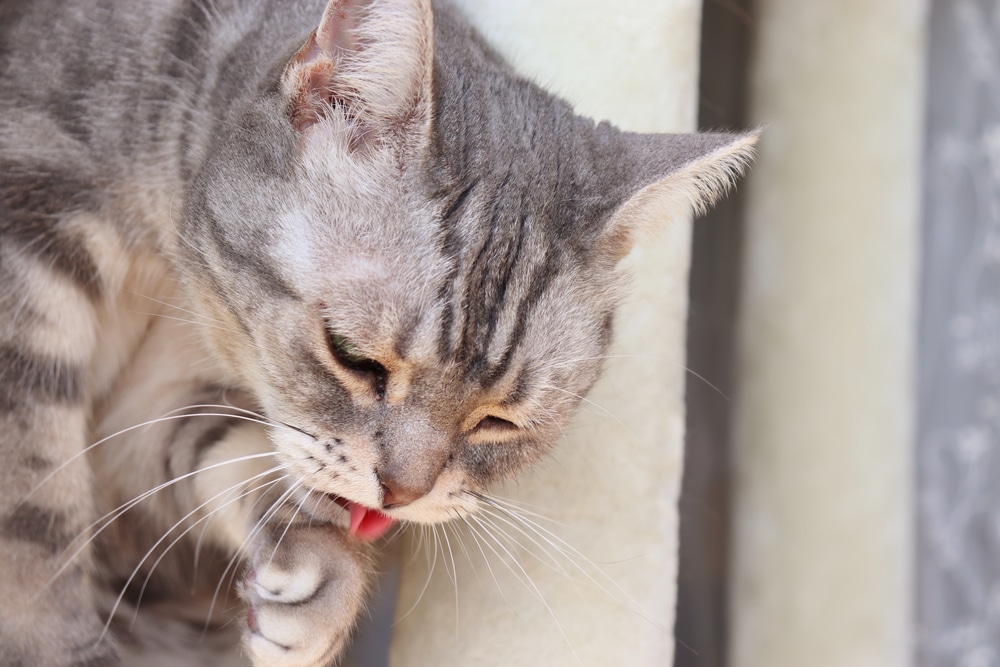
Frequent vomiting is not a normal part of a healthy cat’s life, even though many people shrug it off as “cats just like to vomit”. The truth is that vomiting is a symptom of many different diseases, and often one of the first signs we see that something is wrong. A genuinely normal cat brings up the occasional hairball and is otherwise fine; an abnormal pattern is regular vomiting, vomiting tied to meals, or vomiting alongside weight loss or appetite changes. The trouble is that cats hide illness well, so one who vomits once or twice a week can look perfectly healthy while something develops underneath. Learning where the line sits between a normal hairball and a concerning pattern is what keeps a treatable problem from being waved off for years.
At Cane Bay Veterinary Clinic in Summerville, we are Summerville’s only Fear Free Certified Practice, so we put real thought into how your cat experiences a workup, not just what we are looking for. Our diagnostic services include in-house bloodwork, digital radiography with AI-assisted review, in-house cytology, and access to board-certified specialists for abdominal ultrasound and complex pathology. If your cat has been vomiting more than you would like to admit, call us and we will help you figure out what is behind it.
Where the Normal Line Sits
- An occasional hairball is normal: every few weeks at most for a long-haired cat, less for a short-haired one.
- Weekly vomiting is not: a pattern that recurs or rises over time deserves a workup.
- Context decides: weight, appetite, and energy alongside the vomiting matter as much as the vomiting itself.
What Is Actually Normal for a Cat?
A normal, healthy cat vomits rarely. The occasional hairball counts as normal, roughly once a month at most for a long-coated cat and less often for a short-coated one, as does a single episode after eating too fast that resolves on its own. Outside of those, vomiting is not a routine feature of feline life.
What truly normal looks like is a cat who, between those rare episodes, eats well, holds a steady weight, plays, and uses the litter box normally. The intermittent vomiting some cats show is worth watching rather than dismissing, because occasional can quietly become weekly without anyone marking the shift. Knowing your own cat’s baseline, how often and what it usually looks like, is what lets you notice when that baseline changes.
What Makes Vomiting Abnormal?
Vomiting crosses from normal into concerning along a few clear lines: how often it happens, when it happens, and what else is going on with the cat. Frequency is the simplest signal, since a cat bringing up something weekly or more is well past normal. Timing matters too, with vomiting right after every meal or first thing on an empty stomach each pointing in different directions. Most telling is context: a cat losing weight, eating less or more than usual, drinking more, hiding, or dropping in energy alongside the vomiting has moved firmly into workup territory, regardless of how the vomiting alone might look.
How Do You Tell Normal From Concerning?
Laid side by side, the difference is easier to see than it feels in the moment.
| Feature | Usually normal | Worth a workup |
| Frequency | A hairball every few weeks at most | Weekly or more, or rising over time |
| Timing | A one-off that resolves | Recurring, or tied to every meal |
| The cat otherwise | Eating, playing, steady weight | Losing weight, picky, low energy |
| What comes up | An occasional hairball | Bile, food, blood, or foam, repeatedly |
If your cat lands in the right-hand column on even one row, it is worth a conversation rather than a wait.
Why “Cats Just Do That” Is a Costly Myth
The belief that cats are simply pukey animals is the single biggest reason feline illness goes undiagnosed. Because vomiting is a nonspecific sign with no single obvious cause, it is easy to file under normal and move on, and cats reinforce the habit by acting fine between episodes. The cost shows up later, when a cat finally presents with weight loss or dehydration and the underlying disease has had months to progress. Routine wellness exams and a low bar for investigating a vomiting cat are what catch these conditions early, while treatment is simpler and works better.
What Can Abnormal Vomiting Signal?
Once vomiting is clearly abnormal, the list of possible causes is long, which is exactly why a pattern outside the normal range deserves a look rather than a guess. The common culprits group into a few categories.
- Something swallowed or toxic: gastrointestinal foreign bodies, especially string or ribbon, and toxic plants such as lilies, which are catastrophic for cats.
- Senior-cat disease: chronic kidney disease and hyperthyroidism are leading causes in older cats, which is why recognizing senior pet health problems early matters.
- Chronic GI disease: inflammatory bowel disease and intestinal lymphoma, told apart only with advanced testing.
- Diet sensitivities: food allergies confirmed through a careful elimination trial rather than blood or saliva tests.
- Organ and metabolic disease: pancreatitis, liver and gall bladder disease including the dangerous hepatic lipidosis in cats who stop eating, and feline diabetes.
- Stress or eating too fast: eating too quickly, feeling competition from other pets, and other stress can contribute to vomiting right after a meal
Parasites belong on the list too, since even indoor cats can pick them up, which is why a fecal test is part of a vomiting workup.
What Does the Vomit Itself Tell You?
The appearance of vomit offers clues worth noting before a visit. Yellow bile often means an empty stomach, undigested food soon after eating suggests blockage or regurgitation, coffee-ground brown can mean digested blood, and bright red means active bleeding. Appearance narrows the possibilities but rarely settles them alone, so a recurring pattern still warrants a look. Snapping a quick photo, or noting the color and timing, gives us more to work with than memory alone.
When Is a Vomiting Cat an Emergency?
Some situations cannot wait. Urethral obstruction, most common in male cats, can include vomiting as toxins build, alongside straining in the litter box without producing urine, and it can prove fatal within hours. Blockages from foreign bodies, like from eating hair ties, string, or any number of household objects, is also a surgical emergency. Treat the following as same-day urgent:
- A male cat straining or crying in the litter box: with or without vomiting, this is an emergency.
- Repeated vomiting in a few hours: or refusing food and water for 24 hours.
- Marked lethargy: especially in a cat already quiet at baseline.
- Blood in the vomit, or a swollen, painful belly: both need prompt evaluation.
For same-day urgent care, please call ahead so we can be ready.
What Does a Vomiting Workup Actually Involve?
When the pattern moves past normal, the question shifts from “is something wrong” to “what specifically is wrong.” A workup is how we sort through the list of possible causes systematically rather than guessing. Most workups happen in stages, with each step informed by what the previous one showed, and the goal is to find the answer with the least invasive testing your cat actually needs.
History and physical exam
We start with conversation and hands. When did the vomiting start? How often is it happening? What does it look like? What is your cat eating? How is her weight, energy, and litter box behavior? The physical exam adds palpation of the abdomen (looking for thickened intestines, masses, organ enlargement), assessment of body condition, hydration status, oral exam, and a thyroid check. A surprising amount can be narrowed down before any test is run.
Bloodwork and urinalysis
This is almost always the first round of testing for a vomiting cat. A complete blood count looks for infection or inflammation. A chemistry panel evaluates kidney values, liver enzymes, blood glucose, electrolytes, and protein levels, screening for the metabolic causes (kidney disease, liver disease, diabetes, pancreatitis) that account for a meaningful share of chronic feline vomiting. A thyroid (T4) level is standard for cats over 7 because hyperthyroidism is one of the most common causes of vomiting in older cats. Urinalysis adds information about kidney function and concentrating ability that bloodwork alone doesn’t capture.
In many cases, basic bloodwork and urinalysis either identify the cause or significantly narrow the next step. Our in-house lab gives us same-visit results so we can move forward at the same appointment rather than waiting days for answers.
Fecal testing
Even indoor cats can carry intestinal parasites, and a fecal test is a low-cost, easy step that occasionally produces the whole answer. We typically run it as part of any vomiting workup rather than assuming an indoor cat is parasite-free.
Imaging: radiographs and ultrasound
If bloodwork doesn’t explain the vomiting, imaging is usually the next step. Radiographs (X-rays) give us a look at the overall shape and position of abdominal organs, identify obvious foreign bodies, check for gas patterns that suggest obstruction, and screen for masses. Our digital radiography with AI-assisted review catches subtle findings that benefit from a second set of eyes.
Abdominal ultrasound goes further, allowing real-time evaluation of intestinal wall thickness and layering (the hallmark of inflammatory bowel disease and lymphoma), lymph node size, organ structure, and the appearance of the pancreas. Ultrasound is the test that often differentiates “something inflammatory is happening in the gut” from “everything looks normal here, let’s keep looking elsewhere.” We coordinate with board-certified specialists for ultrasound when more advanced imaging is needed.
Food elimination trials
For cats with chronic vomiting where bloodwork and imaging don’t reveal a clear answer, a food elimination trial is often the next step. This involves feeding a strictly controlled diet (a novel protein your cat has never eaten before, or a hydrolyzed protein diet where the proteins are broken down too small to trigger an immune response) for 8 to 12 weeks with no treats, no table food, no flavored medications, and no exceptions. The trial is genuinely diagnostic only if it’s done strictly.
GI biopsy
When chronic vomiting persists despite bloodwork, imaging, and a food trial, GI biopsy is often what gives us the definitive answer. The question that biopsy most often resolves is the one that imaging can suggest but not confirm: is this inflammatory bowel disease, or is it intestinal lymphoma? The two conditions can look nearly identical on ultrasound and clinical presentation, but they require very different treatments and carry very different prognoses.
For cats with imaging changes throughout the GI tract or concerns about deeper disease, surgical biopsy is often the best next step. Surgical care at Cane Bay is state of the art and focuses around your pet’s comfort, with personalized anesthesia and pain plans, technicians dedicated to monitoring your pet, and plenty of love and snuggles.
The principle behind the workup
Not every vomiting cat needs every test. The goal is to find the answer with the least invasive workup that actually answers the question, building up from bloodwork to imaging to dietary trials to biopsy only as needed. Many vomiting cats are diagnosed on bloodwork alone. Others need the full sequence. The decision about how far to go depends on what we find at each step, how your cat is doing, and what makes sense for your situation. Cane Bay offers the diagnostics needed to find the answers for why your cat keeps vomiting, and the treatment options to tackle whatever we do find.
How Do You Support a Healthy Baseline?
Not every cause is preventable, but a steady routine reduces the avoidable vomiting and makes the abnormal kind easier to spot.
- Genuine hairball help: regular brushing plus products like hairball control soft chews and Laxatone hairball treatment for the cat whose hairballs are truly the issue.
- Settled feeding: scheduled meals, slow-feed bowls for fast eaters, and gradual food transitions over a week or more.
- The right food: the wet or dry food choice depends on the individual cat, and we carry sensitive stomach diets and feline probiotics for supportive care.
- Steady hydration: multiple water sources, or a fountain for cats who like running water.
A personalized nutrition plan built around your cat’s age and any conditions is part of what we sort out at a wellness visit.
Frequently Asked Questions About Cat Vomiting
How Often Is Too Often for a Cat to Vomit?
More than once a month is worth a conversation, and weekly or more is worth a workup. A single episode with an obvious cause that resolves can usually wait for the next wellness visit, while a pattern that recurs or climbs deserves earlier attention.
My Cat Eats Fast and Throws Up. Is That Normal?
It is common, but not normal. The fix is usually mechanical: a slow-feed bowl or puzzle feeder that forces smaller bites. If slowing the eating does not stop it, something else is likely going on.
Should I Withhold Food After My Cat Vomits?
For one episode in a cat acting otherwise fine, a short 8-to-12 hour fast followed by a small bland meal is reasonable. Do not fast a cat longer than that, since cats who stop eating risk hepatic lipidosis. A cat who has not eaten in 24 hours should be seen.
Is It Normal for My Cat to Vomit After Eating Grass or Plants?
Bringing up grass occasionally is fairly common and usually harmless on its own, but two cautions apply. Eating houseplants is a different matter, since several are toxic to cats, and a cat reaching for greenery far more than usual can be signaling nausea rather than appetite. An occasional grass episode in an otherwise thriving cat is not alarming, while a new or growing habit is worth mentioning.
My Cat Has Vomited a Little for Years. Is It Too Late to Check?
It is not too late, and it is worth doing. A long-standing low-level pattern is exactly the kind that gets normalized, yet many of the conditions behind it, from inflammatory bowel disease to early kidney or thyroid disease, are easier to manage the sooner they are found. Baseline bloodwork gives us a starting point even if your cat seems fine today.
Getting Answers for Your Vomiting Cat
The “she just does that” interpretation costs cats time. If your cat has slipped from an occasional hairball into a regular pattern, or anything else has changed alongside it, the question is no longer whether something is going on but what specifically. A workup is usually straightforward and often points to a treatable diagnosis that resolves once we know what we are dealing with.
To set up a visit or talk through what you are seeing, request an appointment or reach out to our team and we will find a time that works.








Leave A Comment